
I stood by my father’s side and tugged on his sleeve. His newspaper rustled as he closed it and turned to me with a “what’s up?” look on his face.
“Dad, when I grow up, I’m going to write a book about traveling the world,” I said, quite proud of my declaration. He looked thoughtful before he replied with a grin.
“Oh, Mary, I know you feel that way now, but you will grow up, get married, and have children. Go along now and help your mom with the dishes,” he said, nodding towards the kitchen and returning to his paper. I was twelve years old and the oldest of four kids; the youngest was five.
I can only imagine how deflated I must have felt. Just the year before I had watched an episode of The Mickey Mouse Club about Darlene, one of the Musketeers, spending a day at TWA’s Stewardess Training. I wanted to become a stewardess. Another new TV program had also snagged my interest. Billed as The Gale Storm Show, “Oh Susanna,” it highlighted the misadventures of a cruise ship’s social director. I wanted to become a social director. Being a stewardess or a social director sounded more appealing than getting married and having children. Not even a teen, I was looking for an escape, having more than enough reasons to do so.
I craved a means of relief from my inherited propensity for Obsessive, Compulsive Disorder (OCD). As a child, I learned I could break the OCD cycle by delving into books and immersing myself in TV shows. This only helped for a short time but at least provided a momentary escape from my anxiety. My strict Catholic upbringing had added to my OCD cycles, the fear of going to hell imagined over and over again.
Just 20 and traveling the world for work
I felt I had hit the jackpot when I became a stewardess for Delta Air Lines in 1965, a few months after turning 20. I flew mostly in the U.S. when I was working, but took advantage of world travel on vacations—from Egypt to Thailand, from Peru to Hong Kong, from Italy to East Africa, and more. Traveling, with all its distractions, became another escape and provided some mental relief.
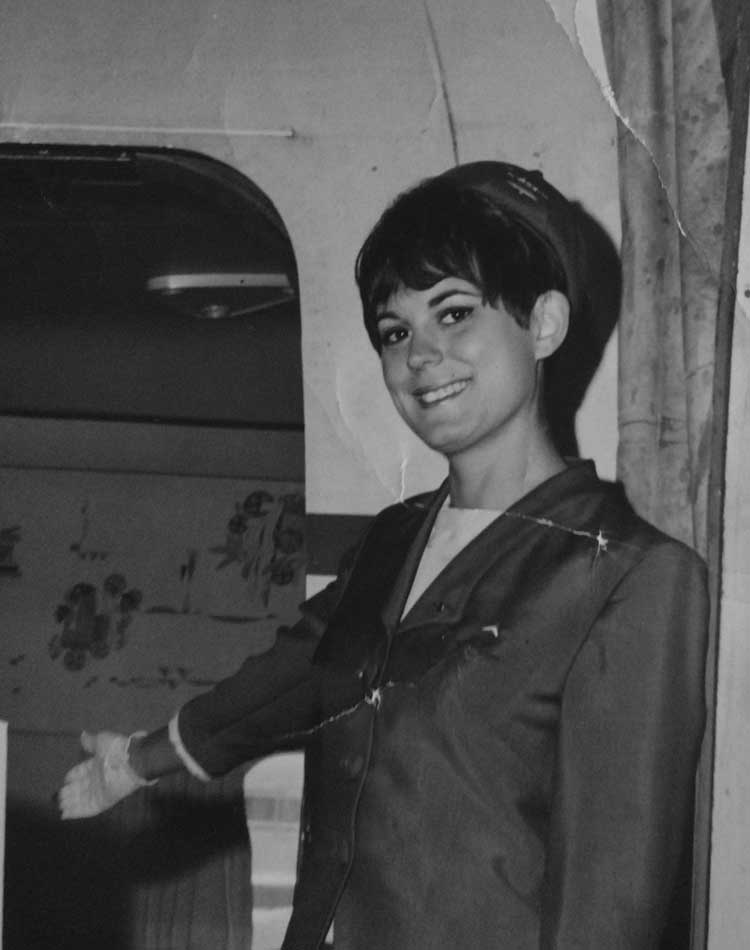
I had been a flight attendant for Delta Air Lines for 18 years, unmarried and without children, when a colleague convinced me to go to China. A year later, I arrived there unaware that the country would become my life’s passion, transforming my emotions, my spirituality, and even my sexuality. Eventually I divided my life into before China and after China.
Soon synchronicities started to be a constant in my life, or at least I started to pay closer attention to them. What I had once called a coincidence, I now examined to see if it held more than just chance. Synchronicities felt like a hand was behind them, and I trusted what they had to tell me. As will be seen in this book, there are times they affirm I am “in the flow.” But there are also times when a synchronicity might mean: look at what you are doing, be aware you might need to change. My experience of synchronicity has been one of the closest links I have had to a higher self and higher power.
Synchronicity will be forever linked to a transformative song, “Memory,” from the play Cats. I would hear it at strategic times in China, affirming I was on the right path or in the right place. I would hear it and imagine being with my beloved cat Peanut, who lived almost 25 years and played a significant role in my life.
The title of my book, Butterfly Dreams, was chosen for several reasons. The butterfly, the ultimate symbol of transformation, has appeared in my life with clear synchronistic regularity, as I share in the second half of the book. Over my years in China, I had learned about a Chinese Sage, Zhuang Zhou, who muses: is he a butterfly dreaming he is Zhou, or is he Zhou dreaming he is a butterfly? When I saw the sculpture of him as the body of a butterfly at an eco-village, I knew I had found the title of my memoir.
Butterfly Dreams: In Five Parts
Part One begins in the fall of 1983 on my first night in Hangzhou, China. Five months after that first trip, I returned without the safety net of a tour, facing many rewards as well as challenges. My experiences in Tibet a year and a half later resulted in a deep knowing that if I could survive Tibet, I could do just about anything. My trip in 1986 culminated in my desire to share China with others and to study Mandarin Chinese.
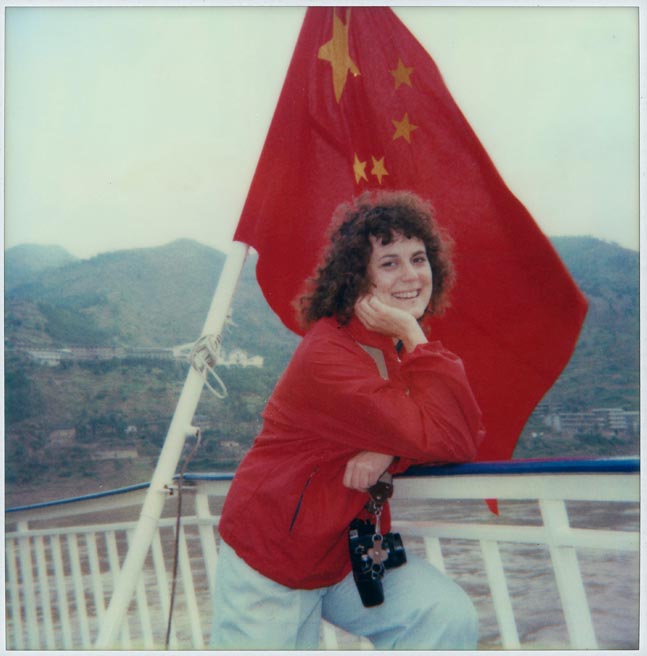
Studying Chinese brought me to the US-China People’s Friendship Association—New England Chapter, where I volunteered teaching English as a Second Language to Chinese scholars and their families. I began to more fully understand why the friendship between the U.S. and China has been euphemistically described as dependent on the “winds of change.” I remember a nun in my grade school warning us that China was the country to be feared, not Russia. Why she would say this to the children in her classroom in the 1950s, I have no idea. Nonetheless, it stuck with me and I thought the friendship organization was a way to promote peace. I took airline employees and their families to China on friendship tours between 1991–1994.
Although one would expect Part Two to highlight those tours, I found that the story of my infatuation with our guide on the first friendship tour wanted to be told. While writing and reliving this part of my life, I finally, so many years later, came to understand the dynamics that had unfolded at that time.
Part Three takes place from the mid-1990s to 2007 with the emphasis on the mid-90s when Delta Air Lines offered leave-of-absences in their downsizing effort. My father passed away in 1993, leaving a small inheritance that enabled me to take a three-year leave to teach English in China. I found a way to carry Peanut into the country, only to have her die within the first month. Her loss made the trials and tribulations of living in a foreign country more challenging as I came to realize that living in China was not the same as visiting China.
Part Four begins in 2011 when I attended the Awakening the Dreamer, Changing the Dream (ATD) Symposium developed by the Pachamama Alliance. On a snowy day in January, I walked into my town’s Unitarian Universalist Church for the three-hour presentation. The purpose of the ATD Symposium is to “bring forth an environmentally sustainable, spiritually fulfilling, socially just human presence on our planet.” I was deeply moved by the Symposium and wanted to take it to China. Over the following nine years, I accomplished this goal. Then Covid 19 intervened and changed our world.
Part Five finds me returning to China in the fall of 2023 when Delta flights resumed to Shanghai after the hiatus of the Covid 19 pandemic. Older, I wondered whether I would have the stamina to deal with all the changes there. Most importantly, would I still have a place in my heart for her? Once again, the hand of synchronicity took charge, and the end of this book became the beginning of the rest of my life.

You can order the book from your favorite independent bookstore or purchase it online at these retailers:
 My life's passion: China, Her People, and Her Philosophies
Leave a comment